

In Part 1 of this series, I outlined the need for a hybrid model of federal civil service reform — one that preserves merit principles while streamlining due process and increasing managerial flexibility. In this post, I will examine Tennessee’s 2012 civil service reform as a real-world template that offers both inspiration and caution.
Tennessee’s experience isn’t a perfect match for the federal system — but it provides a compelling demonstration that thoughtful reform is possible. The Volunteer State modernized its system with a mix of performance-based policies, updated appeals processes, and a shift in employment presumptions. The results: improved accountability, more efficient hiring and removal, and a more agile workforce — albeit with legitimate concerns about long-term implications.
This post breaks down Tennessee’s reform, evaluates outcomes and criticisms, and proposes a roadmap for adapting the model to federal agencies.
Why Reform Matters
The Federal Employee Viewpoint Survey clearly shows many federal employees believe their organizations have poor performers that they fail to deal with. The American people clearly want a most responsive government. The approach the Trump Administration chose is severely flawed because it is (1) not based on data and analysis, (2) not achieving claimed savings, and (c) driven by ideology more than good government. Returning to the status quo ante is not a good option because it assumes government worked so well that change is not needed. The federal civil service is still using rules that were designed 75 years ago for a mostly clerical workforce. What we need is a leaner, more responsive, accountable, and effective government that delivers the services the American people need and want.
The Tennessee Civil Service Reform Act of 2012: An Overview
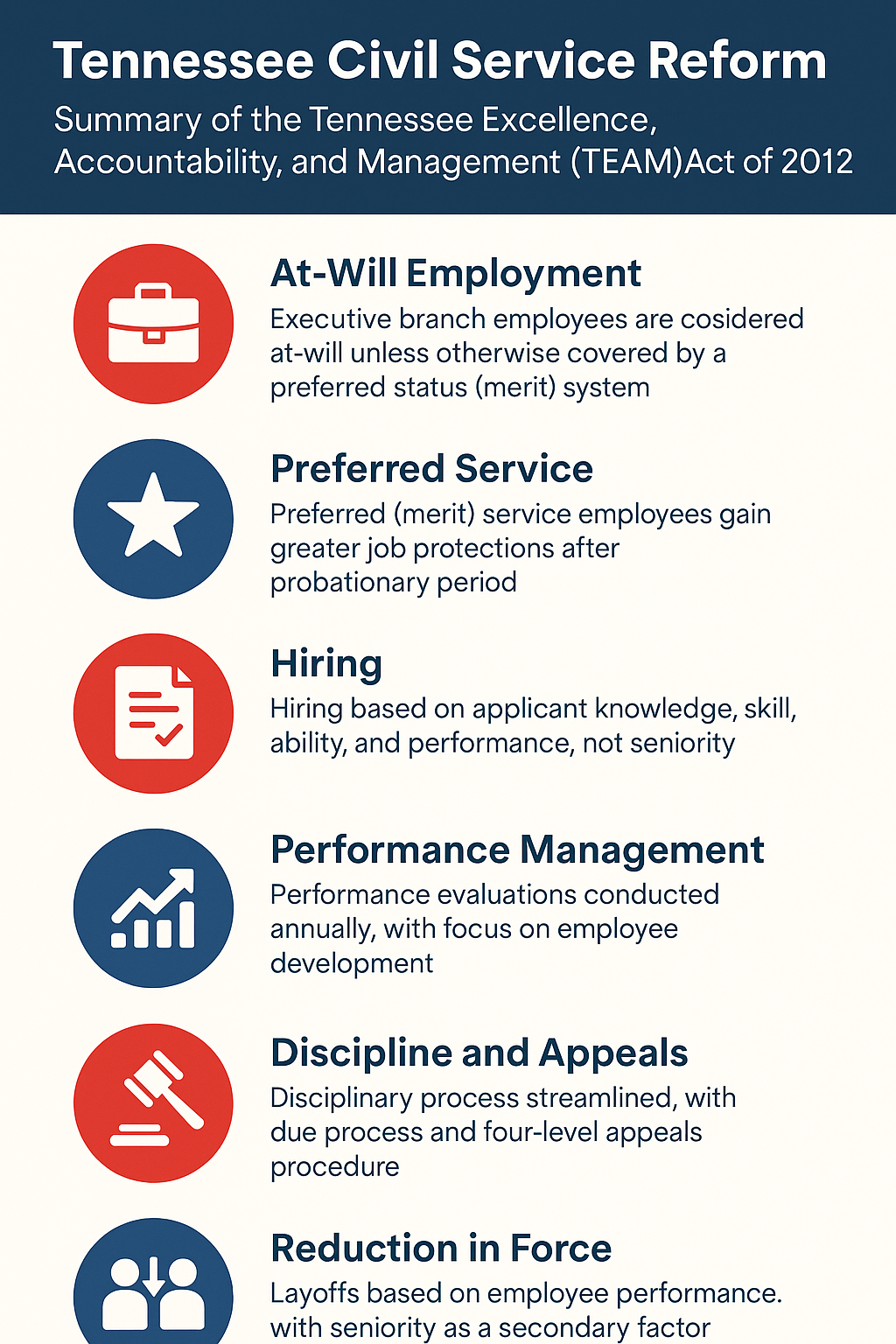
In 2012, Governor Bill Haslam signed into law the Tennessee Excellence, Accountability, and Management Act (TEAM Act). The law significantly overhauled the state’s personnel system for executive branch employees. The goals were to modernize hiring, improve performance management, and align the state workforce with 21st-century operational needs.
Key Changes Included:
- Hiring Reform
- Replaced seniority-based hiring preferences with merit-based, performance-driven selection.
- Hiring managers were given greater discretion and accountability.
- Job postings and the application process were streamlined.
- Performance Evaluation
- Instituted annual reviews with numeric performance scores.
- Performance ratings became directly tied to pay raises and retention.
- Training was aligned with performance goals.
- Removal of Career Tenure for New Hires
- Created a new “Preferred Service” category for employees. Preferred Service employees have successfully completed the required probationary period and have the ability to appeal a suspension, demotion, or dismissal
- Employees hired after July 1, 2013, no longer had traditional tenure protections.
- Job protections are conditional on performance and conduct.
- Appeals Process Overhaul
- Replaced lengthy grievance and hearing processes with a streamlined path through the Department of Human Resources.
- Deadlines were imposed for resolution — often within weeks.
- MSPB-style processes were eliminated.
- Increased At-Will Hiring for Specific Roles
- Broader use of executive service (at-will) appointments.
- Flexibility in hiring for specialized or short-term positions.
Early Results and Ongoing Outcomes
Several years into implementation, multiple studies and reports evaluated Tennessee’s reforms. Tennessee’s Department of Human Resources also has issued a number of reports citing specific outcomes of the TEAM Act reforms:
- Significant Increase in Applicants: The reports highlight a robust rise in interest for state government jobs. For example, the most recent report indicates unique applicants grew by 62% and total applicant volume by 56% between 2023 and 2024, showing a broader and more competitive applicant pool. Previous years also saw substantial jumps, with a 32.5% increase in applicants from 2022 to 2023, and a 45.4% increase from 2021 to 2022.
- Decreasing Turnover Rates: The annual reports note that turnover decreased significantly. There was a 22% reduction in turnover in 2024, translating to fewer vacancies and a more stable workforce. Turnover fell from nearly 18% in 2022 to just under 13% in 2023.
- Recruitment Strategies and Employer Branding: The reports attribute recruitment success to targeted strategies, such as updating the salary structure through the “Total Compensation” project. These efforts helped make the state government more competitive and attractive, as reflected in Forbes’ recognition of Tennessee as one of America’s Best Employers.
- Faster Filling of Vacancies: The time to fill positions improved, with the average days to fill a job ranging from 47–53 days, depending on the year reported. (The federal government struggled to meet OPM’s 80-day target, with few agencies actually meeting the targets)
- Diversity and Outreach: The annual reports emphasize outreach and success in attracting a diverse workforce, reflecting efforts to be inclusive across generations, genders, ethnic, and racial backgrounds.
- Reasons Employees Stay: Top factors for employee retention include work-from-home options (16%), competitive pay (16%), retirement benefits (15%), comprehensive health/wellness benefits (13%), supportive supervisors (12%), meaningful work (12%), and flexible schedules (10%).
- Legislative and Professional Development Initiatives: The Department of Human Resources actively supported legislative measures and expanded learning and leadership development programs to further support workforce engagement and progression.
Hiring Efficiency and Quality
- Hiring times dropped by nearly 30% within the first three years.
- Agencies reported greater ability to recruit talent, especially in IT and health services.
- The “rule of three” was eliminated, allowing hiring managers to choose from a wider candidate pool.
Source: Tennessee Department of Human Resources, Annual Reports (2013–2016)
Performance and Accountability
- Nearly 90% of employees received satisfactory or above performance scores in early years.
- Supervisors reported greater willingness to address poor performance.
- Voluntary and involuntary separations increased — suggesting a more dynamic workforce.
See Walters, J. (2015). “Civil Service Reform in the States: A Realistic Assessment,” IBM Center for The Business of Government.
Appeal Efficiency
- Appeal durations reduced from months or years to approximately 45–60 days.
- Reduction in appeal volume due to clearer expectations and faster resolutions.
- Critics argue, however, that the process lacks full independence.
National Association of State Personnel Executives (NASPE), 2016 Reform Roundtable.
Political Neutrality and Equity Concerns
- Some public employee unions and advocacy groups have raised concerns:
- Lack of clear external appeal venues.
- Fears of political favoritism in executive service appointments.
- Unequal application of standards across agencies.
See: Coggburn, J. D. (2016). “The Tennessee Civil Service Reform and its Implications.” Public Administration Review, 76(3), 423-432.
What the Federal Government Can Learn
Federal personnel policies differ significantly from Tennessee’s. The federal workforce is more diverse, complex, and embedded in constitutional and statutory protections. Yet Tennessee’s reforms provide a roadmap for modernization — if adapted with care.
Key Federal Reform Concepts Inspired by Tennessee:
| Area | Tennessee Reform | Federal Adaptation Proposal |
|---|---|---|
| Hiring | Greater discretion for managers | Eliminate category rating and arbitrary limits on the number of candidates referred for consideration; expand direct hire authority; implement Veteran Preference reform outlined in National Academy of Public Administration white paper “Expanding Opportunities for Veterans and Simplifying Federal Hiring” |
| Performance Management | Numeric ratings tied to pay | Integrate automated performance tools; tie to incentives |
| Job Security | Conditional tenure post-2013 | Replace career-conditional and career tenure with “Preferred status” after 3–5 years of satisfactory service, depending on the type of work. |
| Appeals | Centralized, fast resolution in DOHR | Establish centralized appeals unit within OPM, incorporating MSPB’s appeals staff and resources. Fold MSPB’s excellent merit systems studies unit into the Office of Special Counsel. Reform OPM by revisiting the Civil Service Commission model of a multi-member board to oversee OPM policy and operations, requiring an equal number of democrat and republican members and an Executive Director appointed by the President to serve as Chief Operating Officer. Prohibit political appointee involvement in disciplinary and adverse actions, except those affecting employees who report directly to a political appointee. Remove fee-for-service functions from OPM and limit OPM to policy and oversight roles. |
| At-Will Roles | Broader executive service hiring | 5 year renewable term positions for key roles, including many Senior Executive Service and other policy-determining positions. |
| Transparency | Publicly reported outcomes | Require annual reports on removals, appeals, and ratings |
Reform with Guardrails: Avoiding Federal Pitfalls
Any effort to apply Tennessee’s lessons must also anticipate what could go wrong in a federal context:
- Guarding Against Politicization
- Independent merit oversight bodies (e.g., new OPM Merit Board) must be retained. Appeals staff subject to removal only for cause.
- Transparent metrics on removals and performance outcomes should be published.
- Political appointees should have limited authority over career hiring or removal.
- Protecting Civil Rights and Due Process
- Federal appeals should preserve basic protections: notice, evidence, representation.
- Use of technology should not replace human judgment in high-stakes decisions.
- Safeguarding Whistleblower Protections
- Fast-track procedures should not preclude the ability to raise protected disclosures.
- Oversight offices (e.g., OSC) should be fully resourced and integrated into reform.
- Avoiding Managerial Arbitrage
- Supervisors should be trained and held accountable for fair, evidence-based decisions.
- Anonymous employee feedback on supervisory behavior should inform audits.
Implementation Priorities
Reform cannot happen all at once. A phased implementation of a Tennessee-style hybrid system should prioritize:
- Pilot Programs in Select Agencies
- DHS, VA, or DOD components with high turnover or performance challenges.
- Statutory Reform with Stakeholder Input
- Convene a reform task force with bipartisan Hill staff, unions, managers, and scholars.
- Centralized Reform Unit in OPM
- Modeled on the Tennessee DOHR, to guide rollout, training, and measurement.
- Modern Technology Support
- Use cloud-based dashboards to track performance, removals, and appeals in real-time.
- Scholarly Review
- Partner with GAO, the National Academy of Public Administration, and academic institutions to assess efficacy over 3–5 years.
Conclusion
Tennessee’s civil service reform demonstrates that meaningful change is possible — if done thoughtfully. Their model shows how hiring can be modernized, performance managed fairly, and appeals resolved efficiently. But the lessons are not just in what Tennessee did — they are in how it did it: through sustained leadership, clear statutes, and a willingness to challenge long-standing conventions.
A federal adaptation of this model, done carefully and with proper safeguards, could revitalize the civil service without abandoning its core principles. It won’t be simple — but neither is maintaining a dysfunctional status quo.
Let’s learn from the states. Let’s build a system that works for today’s federal workforce and the citizens they serve.

 ChiefHRO.com